
Sea Freight Company in Saudi Arabia | 0555915287 Full and Shared Containers and Car Shipping to Turkey, North Africa and Lebanon
 Turkey

Sea freight from Saudi Arabia is the practical way to move household furniture, cars and large cargo abroad: your shipment is loaded into a 20 ft or 40 ft container at your door in any Saudi city, taken to Jeddah Islamic Port or King Abdulaziz Port in Dammam, and sails to Turkey, Morocco, Tunisia, Algeria, Libya and Lebanon in roughly 15–25 days port to port. Al Saif International Shipping handles booking, packing, loading, Fasah export clearance and the Bill of Lading through to delivery. Prices start from SAR 2,350 for a 20 ft container to Lebanon, SAR 5,600 to the Maghreb countries and SAR 6,000 to Turkey, with sedans from SAR 1,700. To book or ask: 0555915287.
⚓ The Kingdom’s Sea Freight Compass
- Ports: Jeddah Islamic Port on the Red Sea and King Abdulaziz Port in Dammam on the Gulf, plus Jubail, Yanbu and King Abdullah Port when needed.
- Shipping modes: your own full container (FCL), space in a shared container (LCL), or a RoRo vessel for cars.
- Containers: 20 ft, 40 ft, 40 ft high-cube, reefer, flat-rack and open-top.
- Sea destinations: Turkey, Morocco, Tunisia, Algeria, Libya, Lebanon, and the UAE for commercial containers.
- Transit: roughly 15–25 days port to port depending on destination and sailing schedule.
- Collection: Riyadh, Jeddah, Makkah, Madinah, Dammam, Khobar, Al Ahsa, Qassim, Tabuk, Abha, Khamis Mushait, Taif, Jazan, Hail and every other city.
Sea Freight Company in Saudi Arabia: What Is Sea Freight and When Should You Choose It?
Sea freight means moving goods on container ships or RoRo vessels from a Saudi port to a port in another country, and it is how most goods, furniture and cars travel between continents. Its strength is that it is priced per container or per cubic metre, not per kilogram as with air, so it becomes more economical the bigger the shipment is. A complete bedroom, a majlis, a large fridge or a car cannot be flown at a sensible cost, but each fits naturally into a container that is closed and sealed at your home and opened only at customs or at your new door.
At Al Saif International Shipping we work with customers from every region of the Kingdom: expatriate families relocating home for good, Saudi families with a second home in Turkey or Morocco, students finishing their studies, and traders who export goods regularly. Each needs a different solution. A family moving a villa needs a 40 ft high-cube, a student shipping ten boxes needs only space in a shared container, and a trader may need a reefer or flat-rack. Our job is to choose with you the container, port and route that suit your shipment and budget.
Sea, Road or Air?
The simple rule: a shipment measured in cubic metres goes by sea, a shipment measured in a few kilograms that must arrive fast goes by air, and road is the natural route to neighbouring countries linked to the Kingdom by direct highways, such as the UAE, the Gulf states, Jordan, Lebanon and Syria, where most household moves travel by truck. But when the destination lies across the Mediterranean or in North Africa, such as Turkey, Morocco, Tunisia, Algeria and Libya, the sea is the only practical route for furniture and cars.
| Comparison | Sea freight | Road freight | Air freight |
|---|---|---|---|
| Suitable for | Full households, cars, commercial cargo | Neighbouring countries | Parcels, documents, urgent items |
| Charged by | Container or cubic metre | Truck or volume | Actual or volumetric weight, whichever is higher |
| Approximate time | 15–25 days port to port | A few days to two weeks | 2–5 days |
| Cost for large volumes | Relatively low | Medium | High |
Why Customers Choose Al Saif for Sea Freight
Because one team handles your shipment from start to finish, so you do not have to juggle a local mover, a packing firm, a shipping agent and a customs broker. We survey the home or receive photos and a list, recommend the container size, book the nearest available sailing, send the dismantling, packing and loading crew, truck the container to the port, clear it through Fasah, hand you the Bill of Lading and stay in touch until it arrives.
- Kingdom-wide coverage: we collect from Riyadh, Jeddah, Dammam, Makkah, Madinah and every city, and move the container to the right port.
- The right port: usually Jeddah for the Mediterranean and North Africa, and Dammam for eastbound containers and some commercial lines.
- Export sea packing: moisture-resistant materials, wooden crates for delicate items, and proper securing inside the container.
- Clear pricing: an itemised quote showing what is included and what is paid at the destination port.
- Continuous follow-up: you receive the container number, Bill of Lading number and vessel name to track the voyage.
Full Container (FCL) or Shared Container (LCL)?
This is the key decision after choosing the destination. A full container load (FCL) means the container is yours alone: it is loaded at your home or warehouse, sealed with a uniquely numbered seal, and nobody touches it until customs at the destination. Less than container load (LCL) means you pay only for the cubic metres your shipment occupies; your goods are consolidated with other customers’ shipments at a consolidation warehouse, then the container is loaded and sails.
When to Choose a Full Container
Once your shipment is around half a 20 ft container or more, a full container is usually cheaper, faster and safer, because the goods never pass through a consolidation warehouse and are not unloaded and reloaded. It is the natural choice for moving a flat or villa, shipping a car with furniture, or a trader with enough goods to fill a container.
When to Choose a Shared Container
When the shipment is small: one room, a few dozen boxes, a student’s belongings or commercial samples. There is no reason to pay for a full container, and the price is based on actual volume. The trade-off is that the shipment waits until the container is full at the consolidation warehouse and is unloaded at another warehouse on arrival, so the transit is a little longer. Shared-container prices depend on volume and destination, so request a quote and we will send the price once we know the cubic metres.
| Criterion | Full container (FCL) | Shared container (LCL) |
|---|---|---|
| Use | The container is yours alone | Space in a container with other customers |
| Pricing | Fixed price per container | Per cubic metre |
| Transit | Shorter, sails on the nearest vessel | Slightly longer due to consolidation |
| Security | One seal from your home to arrival | Unloaded at the destination warehouse |
| Suits | Flats, villas, a car with furniture, commercial cargo | One room, boxes, student belongings, samples |
Sea Container Types and Sizes
Shipping containers follow standard international dimensions, and each type has its use. Knowing the difference helps you avoid paying for space you do not need, or squeezing furniture into space that is too small. Figures in the table are approximate and vary slightly between shipping lines.
| Container type | Approx. internal size (L × W × H) | Approx. capacity | What fits? |
|---|---|---|---|
| 20 ft standard | 5.9 × 2.35 × 2.39 m | About 33 m³, payload about 28 t | A two- to three-bedroom flat, or one car with some furniture |
| 40 ft standard | 12.0 × 2.35 × 2.39 m | About 67 m³, payload about 26 t | A four- to five-room home, or two cars with furniture |
| 40 ft high-cube | 12.0 × 2.35 × 2.69 m | About 76 m³ | A full villa, plus tall pieces such as high wardrobes |
| Reefer | 20 ft: 5.4 × 2.29 × 2.27 m / 40 ft HC: 11.6 × 2.29 × 2.50 m | About 28 m³ or 67 m³ | Food, dates, medicines and temperature-sensitive goods |
| Flat-rack | A 20 ft or 40 ft floor without side walls or roof | For heavy or over-width loads | Equipment, machinery, boats and items that will not fit through a container door |
| Open-top | 20 ft: 5.9 × 2.35 × 2.35 m | About 32 m³ | Long cargo loaded from above by crane |
How Do You Know Which Container Size You Need?
The most accurate way is for us to see the furniture or to receive photos of each room with a list of the large pieces. As a guide, a furnished bedroom takes 8–12 cubic metres once packed, a kitchen with appliances 6–10, and a large majlis 10–15. When the total approaches 30 cubic metres it is time to move from a 20 ft to a 40 ft. We always prefer to leave a small margin, because an overstuffed container puts pressure on the pieces.
Shipping Cars by Sea: RoRo or Inside a Container?
There are two ways to ship a car by sea from the Kingdom, each suited to a situation. On a RoRo (roll-on/roll-off) vessel the car is driven up the ramp into the ship and lashed on dedicated car decks, then driven off at the destination port. With this method the car is never covered or wrapped; it is handed over clean and empty of personal items, because it is driven on the ramp, and no furniture or boxes may be placed inside it.
Shipping a car in an enclosed container means it is lifted into a 20 ft or 40 ft container, secured with straps and wooden wheel chocks, and can be covered and protected, with furniture loaded alongside it in the same container on a full-container shipment. This is the right method for luxury and classic cars, or when the customer wants to move the car together with the household in one shipment.

| Comparison | RoRo | Inside a container |
|---|---|---|
| Loading | The car is driven up the ramp into the ship | Lifted and secured inside the container |
| Covering | Not covered; driven on as it is | Can be covered and wrapped |
| Items inside | Not allowed | Allowed with a full container |
| Suits | Ordinary cars at lower cost | Luxury and classic cars, a car with furniture |
Car Shipping Documents from the Kingdom
- Valid vehicle registration in the owner’s name, or the owner’s authorisation.
- Owner’s ID or iqama and a copy of the passport.
- Export certificate and export plates or deregistration, in line with the regulations in force at the time of shipping.
- A bank letter if the car is financed or mortgaged.
- Consignee details in the destination country.
Car import rules differ from country to country in vehicle age, specifications and duties, so we advise you to confirm the destination country’s requirements before shipping, and we help you understand what is generally needed.
The Saudi Ports We Ship From
The Kingdom has two coastlines, the Red Sea to the west and the Arabian Gulf to the east, each with major commercial ports. Choosing the port is not a detail: it affects transit time, cost and the vessel’s route.
Jeddah Islamic Port: the Western Gateway
Jeddah Islamic Port is the Kingdom’s main port on the Red Sea, and most containers bound for the Mediterranean via the Suez Canal leave from it: Turkey, Lebanon, Libya, Tunisia, Algeria and Morocco. Because it is closer to these destinations, many customers in Riyadh and the central region route their shipments through it despite the road distance. The port also serves customers in Makkah, Madinah, Taif, Yanbu and Jazan.
King Abdulaziz Port, Dammam: the Gulf Gateway
King Abdulaziz Port in Dammam is the main port on the Arabian Gulf, serving the Eastern Province and Riyadh by road and by the rail link from the dry port. Containers sail from it to Gulf ports, India and East Asia, and it also has Mediterranean services that go around the Arabian Peninsula, so their transit is usually longer than from Jeddah.
Other Ports
The Kingdom has other commercial ports such as Jubail Commercial Port on the Gulf, Yanbu Commercial Port on the Red Sea and King Abdullah Port near Rabigh, which we use when the sailing schedule or the shipment’s location makes them the better option.
How Does the Shipment Reach the Port from Your City?
If you are in Jeddah or Dammam, the container usually reaches the port the same day. If you are in Riyadh, Qassim, Abha, Tabuk or Hail, the container is loaded at your home and then moved to the port in one of two ways. The usual way is by truck: the sealed container is mounted on a truck and driven on the highway to Jeddah or Dammam; Riyadh to Jeddah is about 950 km and Riyadh to Dammam about 400 km. The second option for Riyadh customers is Riyadh Dry Port, an inland customs facility connected by rail to King Abdulaziz Port in Dammam, so the container is handed over in Riyadh and travels by train to Dammam.
At the port gate the container is registered and its number and seal number are matched against the data filed in Fasah, then it waits in the export yard until it is loaded onto the vessel. That is why we coordinate the loading appointment at your home with the port’s container cut-off, so the container does not wait long and does not miss the sailing.
Destinations We Ship to by Sea and Transit Times
We ship by sea to the destinations below. Times are approximate port to port, depend on the vessel schedule and ports of call along the way, and do not include loading in the Kingdom or clearance and delivery at the destination.
| Destination | Arrival port | Approx. time | Details |
|---|---|---|---|
| Turkey | Mersin | 15–20 days | Shipping to Turkey |
| Turkey | Istanbul / Ambarli | 18–25 days | Shipping to Turkey |
| Morocco | Casablanca, Tanger Med | 18–25 days | Shipping to Morocco |
| Tunisia | Rades | 18–25 days | Shipping to Tunisia |
| Algeria | Algiers, Oran | 18–25 days | Shipping to Algeria |
| Libya | Tripoli, Misrata, Benghazi | 15–22 days | Shipping to Libya |
| Lebanon | Beirut port | 15–25 days | Shipping to Lebanon |
| UAE | Jebel Ali (commercial containers) | — | Shipping to the UAE |
Turkey
From Jeddah the vessel crosses the Red Sea and the Suez Canal to Mersin in southern Turkey in 15–20 days, or continues to Ambarli port in Istanbul in 18–25 days. We choose the arrival port according to the city you will live in, and deliver port to door in the main cities.
Morocco, Tunisia and Algeria
Containers arrive at Casablanca or Tanger Med in Morocco, Rades in Tunisia, and Algiers or Oran in Algeria in roughly 18–25 days. These are important destinations for families living in the Kingdom who return home with their furniture and car.
Libya and Lebanon
Containers reach Tripoli, Misrata or Benghazi in Libya in 15–22 days, and Beirut port in 15–25 days. Lebanon can also be reached by road, but a sea container remains a good option for a full household and a car.
UAE
Household moves and cars to the UAE mostly travel by road; sea freight to Jebel Ali is used for commercial containers, and the transit is set by the shipping line and the vessel date.
Sea Freight Prices from Saudi Arabia
The prices below are starting prices for a full container port to port, taken from our country shipping pages. The final price depends on the collection city, shipment volume and packing services required.
| Destination | 20 ft container | 40 ft container | Sedan (shared) |
|---|---|---|---|
| Lebanon | From SAR 2,350 | From SAR 3,750 | From SAR 2,350 |
| Morocco | From SAR 5,600 | From SAR 7,500 | From SAR 1,900 |
| Tunisia | From SAR 5,600 | From SAR 7,500 | From SAR 1,700 |
| Algeria | From SAR 5,600 | From SAR 7,500 | From SAR 1,700 |
| Libya | From SAR 5,600 | From SAR 7,500 | Request a quote |
| Turkey | From SAR 6,000 | From SAR 8,200 | From SAR 5,100 |
| UAE (commercial containers) | Request a quote | Request a quote | — |
Shared-container (LCL) shipping is priced per cubic metre, so request a quote once you know your volume. Destination port charges, customs clearance at the destination and inland delivery to the door are set out in the itemised quote for each shipment.
What Affects the Cost of Sea Freight?
- Container size and type: a 40 ft costs more than a 20 ft, and reefers and flat-racks have their own rates.
- Destination port: each port has different lines and charges, and some require transhipment at an intermediate port.
- Season: demand for containers rises at the end of the school year and before holidays, and prices follow.
- Destination port charges: handling and clearance fees differ from country to country.
- Inland delivery: moving the container from the arrival port to your city is charged by distance.
- Collection city in the Kingdom: cities far from the ports add road transport to the port.
- Packing, dismantling and assembly: wooden crates and special packing cost extra.
How to Save on Sea Freight
- The cheapest way to ship a small load is a shared container (LCL) instead of paying for a full one.
- Get rid of old or heavy, low-value furniture before shipping; shipping it may cost more than it is worth.
- Book early, before peak seasons, to secure space at a reasonable rate.
- Combine the car and furniture in one 40 ft container instead of two separate shipments.
- Ask about port-to-port shipping if you have someone to receive and clear the goods at the destination.
Export Packing for Sea Freight
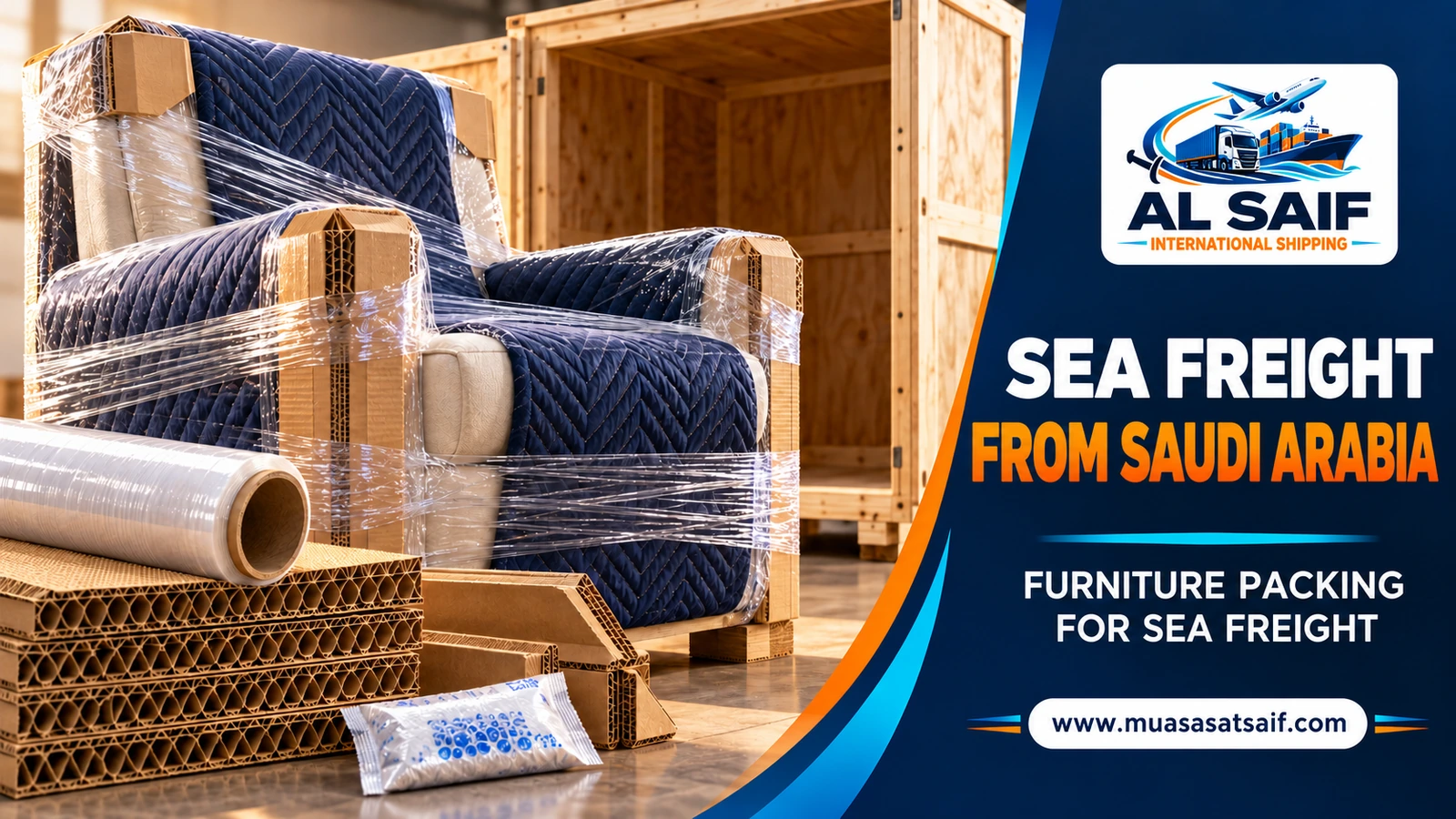
An ocean voyage is not like a move across town. The container spends weeks at sea, goes through temperature changes between ports, faces humidity that condenses on the roof and inner walls, and is shaken by the ship’s motion and lifted by cranes at loading and discharge. That is why we pack furniture to export sea standard, not local-move standard.
Protection from Humidity
We use sealed plastic covers over layers of bubble wrap and cardboard for mattresses, sofas and fabrics, place desiccant bags inside the container, and make sure the furniture is completely dry before wrapping it, especially fridges and washing machines, which must be drained and dried two days before shipping.
Wooden Crates
Delicate pieces such as large mirrors, glass, marble, antiques and screens go into wooden crates made to size from treated timber that meets import requirements in many countries. This protects them from breakage even if the load shifts.
Securing Inside the Container
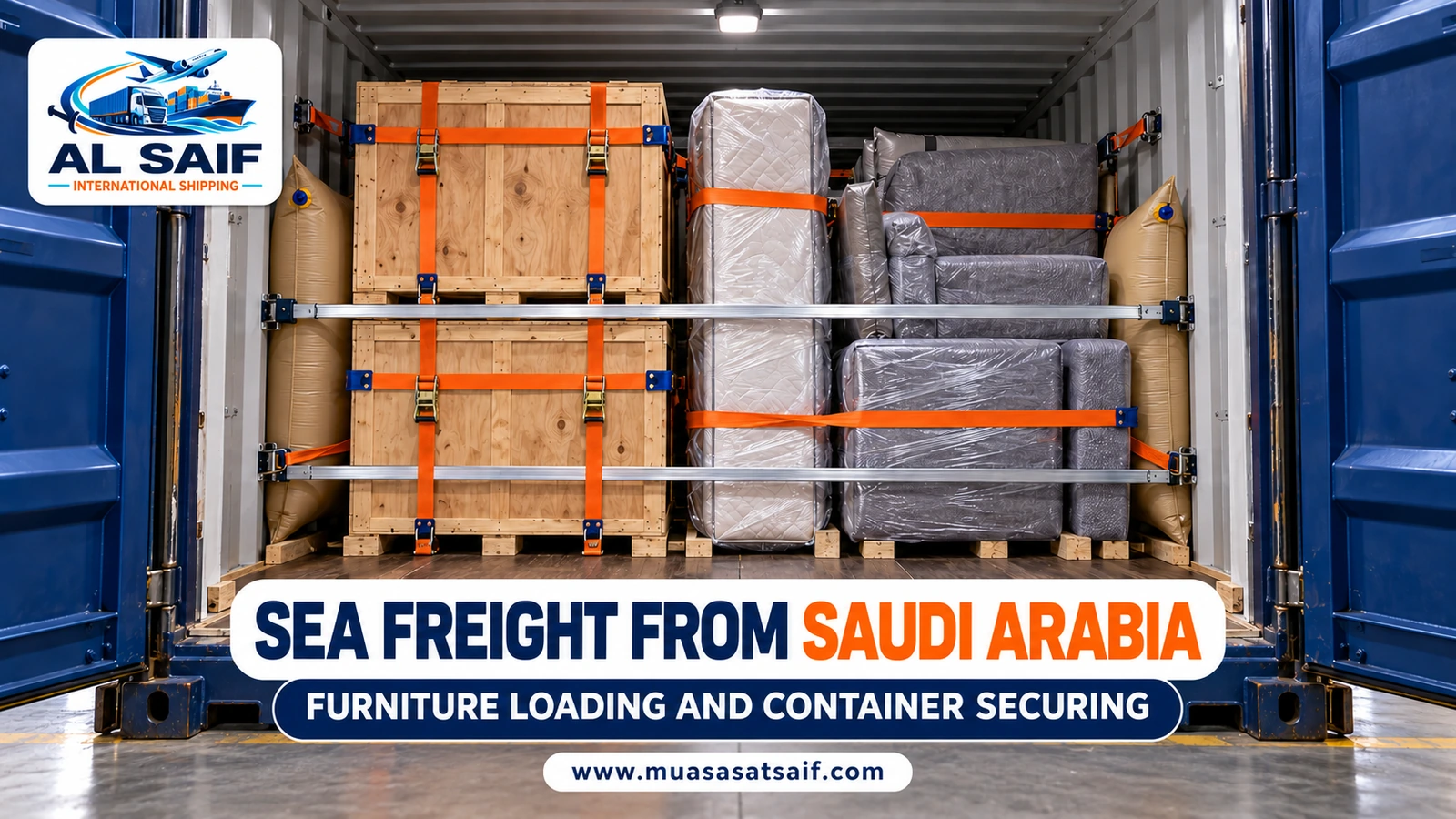
We load heavy pieces at the bottom and light ones on top, fill the gaps with cardboard and air cushions, and tie the load with straps and timber bracing so it cannot move. The aim is for the load to stay one solid block for the whole voyage.
Sea Freight Steps from Saudi Arabia
- Booking: call us on 0555915287 with the destination, city and shipment size; we recommend the container type and send the quote.
- Collection: we schedule the dismantling and packing crew at your home or warehouse.
- Packing: we dismantle, export-pack and number the pieces and prepare the packing list.
- Container stuffing: the container arrives, we load and secure the shipment and seal the container with a numbered seal.
- Fasah export clearance: we file the export declaration on Fasah with your documents and authorisation.
- Bill of Lading: once the container is received at the port, the shipping line issues the Bill of Lading.
- Sailing: the container is loaded onto the vessel and we send you the tracking details.
- Destination clearance: the container is cleared at the arrival port under that country’s rules.
- Delivery: the container is delivered to your door, or you collect it from the port.
Documents Required for Sea Freight
Documents differ slightly between personal effects, commercial cargo and cars, but the basics are the same:
- Bill of Lading: the title document for the shipment, issued by the shipping line and used to collect the container on arrival.
- Packing list: a list of every piece and box and its contents.
- Commercial invoice: for commercial goods, stating their value and type.
- Certificate of origin: for commercial goods where destination customs require it.
- ID or iqama: for the shipper, with a copy of the passport.
- Fasah authorisation: allowing us to file the export declaration in your name on Fasah.
All of this follows the regulations in force at the time of shipping, and destination customs may ask for additional documents such as proof of new residence or the consignee’s tax details.
Customs at the Destination
Each country has its own rules for used furniture, cars and commercial goods. In general, used personal effects of returning residents are treated differently from commercial goods, and cars carry their own duties and conditions. We advise you to confirm the current rules in the destination country before shipping, and we help you prepare the documents in the form it requires.
Commercial Cargo by Sea
Alongside furniture and cars we ship commercial cargo: food and dates in reefer containers, equipment and machinery on flat-racks, general cargo in 20 ft and 40 ft containers, and small quantities by shared container. For traders we handle booking, the invoice, packing list, certificate of origin and Fasah clearance.
Air Freight: the Fast Alternative
If the shipment is small and urgent, such as documents, a suitcase, spare parts or personal items you need within days, air freight is the answer. We ship by air from King Khalid Airport in Riyadh, King Abdulaziz Airport in Jeddah and King Fahd Airport in Dammam in roughly 2–5 days depending on the destination. It is charged on actual or volumetric weight, whichever is higher, so it does not suit large furniture. Many of our customers ship their furniture by sea and send what they need straight away by air.
Insurance, Tracking and Storage
Insurance
Insurance can be added for valuable items on request; we agree with you the value to insure before shipping and record the condition of the items with photos.
Tracking
After sailing we send you the container number, Bill of Lading number and vessel name so you can follow the voyage on the shipping line’s website, and we stay in touch until arrival.
Storage
If your new home is not ready, or you are waiting for your travel date, your furniture can be stored in the Kingdom before shipping or at the destination afterwards, whichever arrangement suits you.
Prohibited Items in Sea Freight
The following may not be shipped with household goods or general cargo:
- Flammable and explosive materials such as gas cylinders, petrol, fireworks and pressurised aerosols.
- Weapons, ammunition and their parts.
- Narcotics and banned substances.
- Cash, gold and jewellery in commercial quantities.
- Perishable food in standard containers.
- Large batteries and chemicals without a permit.
- Anything the destination country bans under the regulations in force at the time of shipping.
Sea Freight from Cities across the Kingdom
We serve every city, and each region has its route to the port:
- Riyadh and the central region: by truck to Jeddah (about 950 km) or Dammam, or via the dry port and the rail link to Dammam. Details in Sea freight company in Riyadh.
- Jeddah, Makkah, Madinah and Taif: to nearby Jeddah Islamic Port. Details in Sea freight company in Jeddah.
- Dammam, Khobar, Dhahran, Al Ahsa and Jubail: to King Abdulaziz Port or Jubail, or by road to Jeddah for Mediterranean destinations.
- Qassim and Hail: by truck to Jeddah or Dammam depending on the destination.
- Abha, Khamis Mushait, Jazan and Najran: usually by truck to Jeddah.
- Tabuk and the north: to Jeddah, Yanbu or King Abdullah Port depending on the sailing schedule.
Frequently Asked Questions about Sea Freight from Saudi Arabia
How long does sea freight from Saudi Arabia take?
Roughly 15–25 days port to port depending on the destination: 15–20 days to Mersin, 18–25 days to Morocco, Tunisia and Algeria, and 15–22 days to Libya.
How much is a 20 ft container from Saudi Arabia?
From SAR 2,350 to Lebanon, SAR 5,600 to Morocco, Tunisia, Algeria and Libya, and SAR 6,000 to Turkey.
What is the difference between FCL and LCL?
FCL is a full container for you alone at a fixed price; LCL is space in a shared container charged per cubic metre.
Is the car covered on a RoRo vessel?
No. On RoRo the car is driven up the ramp into the ship, so it is not covered; inside a container it can be covered.
Which port does the container ship from?
Usually Jeddah Islamic Port for the Mediterranean and North Africa, or King Abdulaziz Port in Dammam.
Do you collect from every city in the Kingdom?
Yes, from Riyadh, Jeddah, Dammam, Makkah, Madinah, Qassim, Abha, Tabuk and every other city.
Related Guides
- Sea freight company in Jeddah
- Sea freight company in Riyadh
- Shipping from Saudi Arabia to Turkey
- Shipping from Saudi Arabia to Morocco
- Shipping from Saudi Arabia to Tunisia
- Shipping from Saudi Arabia to Algeria
- Shipping from Saudi Arabia to Libya
- Shipping from Saudi Arabia to Lebanon
- Shipping from Saudi Arabia to the UAE
- Request a shipping quote
Tags: sea freight company in Saudi Arabia, sea freight from Saudi Arabia, container shipping from Saudi Arabia, 20 ft container, 40 ft container, car shipping by sea, RoRo shipping, Jeddah Islamic Port, King Abdulaziz Port Dammam, Al Saif International Shipping
More guides for shipping to Turkey

Shipping Company from Saudi Arabia to Turkey | Furniture Containers, Cargo & Car Shipping to Istanbul and Mersin
Shipping from every city in the Kingdom to Istanbul, Bursa, Ankara, Izmir, Trabzon and all of Turkey: containers of furniture,…
Read the guide
Shipping Company from Riyadh to Turkey | Furniture Moving, Containers & Car Shipping to Istanbul and Bursa
Shipping from every Riyadh district, Al Kharj, Diriyah and Al Sulay to Istanbul, Bursa, Ankara, Trabzon and all of Turkey:…
Read the guide
Shipping Company from Jeddah to Turkey | Sea Container Freight, Home Moving & Car Shipping to Istanbul and Mersin
Shipping from every Jeddah district, Obhur, Makkah, Taif and Rabigh to Istanbul, Bursa, Ankara, Izmir, Trabzon and all of Turkey:…
Read the guide
Shipping Company from Dammam to Turkey | Sea Containers & Car Shipping to Mersin and Istanbul
Shipping from Dammam, Al Khobar, Dhahran, Qatif and Jubail to Istanbul, Bursa, Ankara, Izmir and Trabzon: full and shared containers…
Read the guide
Shipping Company from Al Ahsa to Turkey | Container Home Moving, Car & Date Shipping to Istanbul
Shipping from Hofuf, Al Mubarraz, Al Oyoun, Al Omran, Al Jafr and the villages of Al Ahsa to Istanbul, Bursa,…
Read the guide
Shipping Company from Makkah to Turkey | Home Moving by Sea via Jeddah Port & Car Shipping to Istanbul
Shipping from Al Aziziyah, Al Sharaie, Al Awali, Al Naseem, Al Zahir and every Makkah district, plus Al Jumum and…
Read the guide